Use the build your team already ships.
Run ELF, BIN, and HEX artifacts produced by Zephyr, Rust
no_std, ESP-IDF, or your existing embedded toolchain.
Run the firmware you already build against virtual hardware. Reproduce failures, inspect what happened, and turn every scenario into a repeatable test.
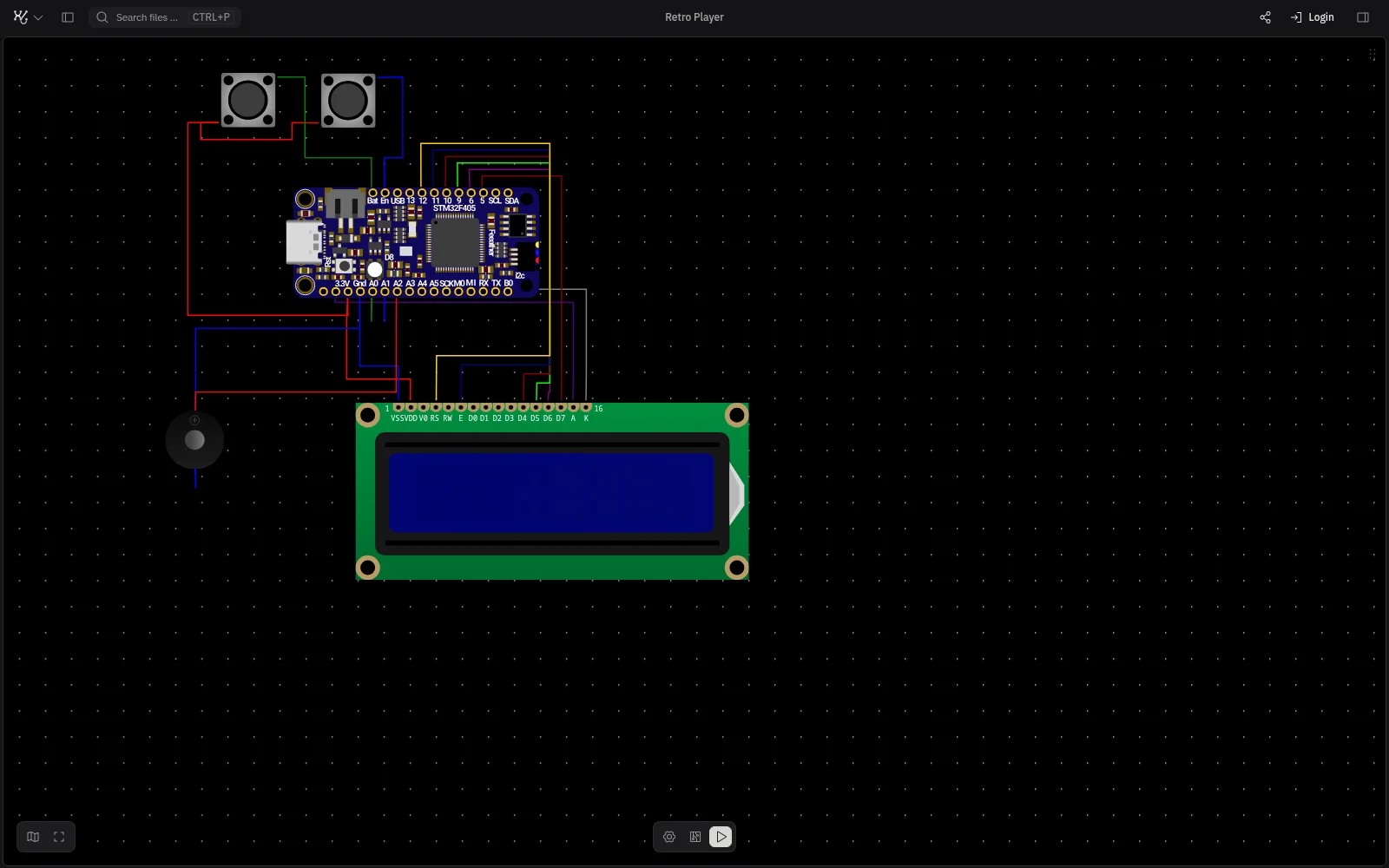 Autonomous inspection drone
 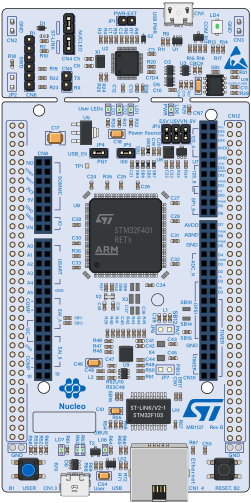 Primary flight controller STM32F767
  Telemetry ESP32-C3
  Safety monitor RP2350
  Motion MPU6050
  Altitude BMP280
  Thermal MCP9808

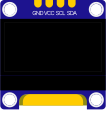 Status SSD1306
 %20rotate(49)%20scale(10.6)'%3e%3cstop%20stop-color='%233B3C3C'/%3e%3cstop%20offset='0.34'%20stop-color='%23242525'/%3e%3cstop%20offset='0.76'%20stop-color='%23111212'/%3e%3cstop%20offset='1'%20stop-color='%23070707'/%3e%3c/radialGradient%3e%3cradialGradient%20id='buzzer-port'%20cx='0'%20cy='0'%20r='1'%20gradientUnits='userSpaceOnUse'%20gradientTransform='translate(5.35%205.25)%20rotate(48)%20scale(3.2)'%3e%3cstop%20stop-color='%23505151'/%3e%3cstop%20offset='0.42'%20stop-color='%23292A2A'/%3e%3cstop%20offset='0.82'%20stop-color='%230A0B0B'/%3e%3cstop%20offset='1'%20stop-color='%23020202'/%3e%3c/radialGradient%3e%3clinearGradient%20id='buzzer-rim'%20x1='3'%20y1='1.2'%20x2='8.6'%20y2='10.8'%20gradientUnits='userSpaceOnUse'%3e%3cstop%20stop-color='%23747575'/%3e%3cstop%20offset='0.28'%20stop-color='%23303131'/%3e%3cstop%20offset='0.72'%20stop-color='%23090A0A'/%3e%3cstop%20offset='1'%20stop-color='%23242525'/%3e%3c/linearGradient%3e%3cfilter%20id='buzzer-shadow'%20x='-14%25'%20y='-14%25'%20width='128%25'%20height='145%25'%20color-interpolation-filters='sRGB'%3e%3cfeDropShadow%20dx='0'%20dy='0.24'%20stdDeviation='0.24'%20flood-color='%23000'%20flood-opacity='0.5'/%3e%3c/filter%3e%3c/defs%3e%3c!--%20Familiar%20round%20molded%20body,%20with%20only%20restrained%20material%20depth%20added.%20--%3e%3ccircle%20data-part='body'%20cx='6'%20cy='6'%20r='5.72'%20fill='url(%23buzzer-body)'%20stroke='%23030303'%20stroke-width='0.42'%20filter='url(%23buzzer-shadow)'/%3e%3ccircle%20cx='6'%20cy='6'%20r='5.25'%20stroke='url(%23buzzer-rim)'%20stroke-width='0.3'/%3e%3cpath%20d='M2.15%203.48A4.7%204.7%200%200%201%206.85%201.36'%20stroke='%23A2A3A2'%20stroke-width='0.17'%20stroke-linecap='round'%20opacity='0.42'/%3e%3cpath%20d='M10.55%207.05A4.7%204.7%200%200%201%205.05%2010.6'%20stroke='%23020202'%20stroke-width='0.22'%20stroke-linecap='round'%20opacity='0.72'/%3e%3c!--%20Recessed%20sound%20opening,%20matching%20the%20scale%20and%20placement%20of%20the%20old%20art.%20--%3e%3ccircle%20data-part='sound-port'%20cx='6'%20cy='6'%20r='2.08'%20fill='url(%23buzzer-port)'%20stroke='%23030303'%20stroke-width='0.28'/%3e%3ccircle%20cx='6'%20cy='6'%20r='1.66'%20stroke='%23777878'%20stroke-width='0.12'%20opacity='0.3'/%3e%3cellipse%20cx='5.48'%20cy='5.35'%20rx='0.64'%20ry='0.28'%20fill='%23B8B9B7'%20opacity='0.11'%20transform='rotate(-18%205.48%205.35)'/%3e%3c!--%20Molded%20polarity%20marker%20retained%20from%20the%20original%20component.%20--%3e%3ccircle%20cx='6'%20cy='2'%20r='0.9'%20fill='%23171818'%20stroke='%235E5F5F'%20stroke-width='0.13'/%3e%3cpath%20d='M5.52%202H6.48M6%201.52V2.48'%20stroke='%23A7A8A7'%20stroke-width='0.18'%20stroke-linecap='round'/%3e%3c/svg%3e) Fault tone
Fault tone  Fault state
 Used by engineers at



Keep your existing toolchain, model the complete device, and scale the same deterministic workload across Simulator86 Cloud.
Run ELF, BIN, and HEX artifacts produced by Zephyr, Rust
no_std, ESP-IDF, or your existing embedded toolchain.
Connect multiple MCUs inside one environment and observe buses, radio, interrupts, and cross-device timing from the same run.
Execute deterministic simulations in parallel without maintaining physical benches or a fleet of custom runners.
Build a system once. Explore it in the IDE, automate it through the SDK, and give engineering agents access through MCP without recreating the project or its scenarios.
Run the shared project from CI, regression suites, and internal engineering tools. Parallelize scenarios and query results programmatically.
Explore the SDK →Give coding agents the same system context to run firmware, inspect state, and investigate failures.
Connect MCP →Open the shared project visually to change hardware, control runtime inputs, and inspect the failing run.
Open the IDE →What engineering teams usually need to establish first.
Simulator86 is a programmable simulation environment for developing, testing, and validating embedded systems before relying on physical hardware.
Yes. Simulator86 runs compiled firmware inside a virtual hardware environment, allowing teams to test the software they intend to ship.
Yes. Simulator86 is framework- and library-agnostic: if your firmware runs on the real supported chip, it runs on Simulator86.
Teams use Simulator86 to develop firmware, reproduce difficult failures, automate testing, and validate system behavior at scale.
Simulator86 supports a growing range of embedded architectures, devices, and connected systems. We evaluate each target system to confirm the right simulation coverage.
Teams can use Simulator86 interactively, integrate it into automated workflows, or connect it to AI engineering tools through the IDE, SDK, and MCP.
Start with a technical evaluation. We’ll review your firmware, target system, and engineering goals to determine how Simulator86 can support your team.

Bring us one firmware build and the failure your team cannot reproduce.
We’ll scope the virtual system, run the scenario, and show your team the evidence Simulator86 can preserve and replay.